
Feeling Emotional about Food in the Early Middle Ages. Some Notes on Food Ambivalences
Wanessa Asfora Nadler
Syracuse University in Florence / University of Coimbra / University of São Paulo
3 June 2025, 15.00-17.00
University of Florence, SAGAS Department, Via San Gallo 10, Aula Parva
Mediterranean Emotions – A Global Research Hotspot
Seminar Series “Emotional Grammars of Globalization”
GMeet Link: http://meet.google.com/chc-uogc-kwg
Abstract
Early medieval thought regarding food is primarily shaped by ecclesiastical views. Theoretically, food can serve one of two roles concerning the human body: it can resemble the forbidden fruit, contributing to the body’s decay due to original sin, or it can function like the Eucharistic host, nourishing and maintaining the glorified body and preparing it for eternal life. There is a necessary understanding of food that must be cultivated, ensuring it does not act as the fruit that deprived humanity of Paradise but rather as the viaticum that will ultimately restore it at the end of time. These concepts seem to be opposing and, at first glance, mutually exclusive. However, in this seminar, I will argue that early medieval thought about food can move beyond these contrasting metaphors—the forbidden fruit and the host—by presenting a more nuanced and ambivalent perspective on food. This ambivalence may evoke various emotional responses related to food, including fear, disgust, contentment, and, perhaps, anxiety. To support this argument, I will re-examine wellestablished writings by scholars such as John Cassian, Augustine, Bede, and Alcuin, in light of contemporary insights from the field of the history of emotions.
Speaker’s Bio
Wanessa Asfora Adler is a historian who specializes in Medieval Food History. She has published several articles in scholarly journals that explore the relationship between food and medicine during the Middle Ages and the Renaissance. Additionally, she authored a book in 2014 focused on the medieval history of the Roman cookbook attributed to Apicius. Currently, she is a faculty member at Syracuse University in Florence. She is also a researcher at the Centre for Classical and Humanistic Studies at the University of Coimbra and at the Laboratory of Theory and History of Medieval Media (Lathimm) of the University of São Paulo and Federal University of Rio de Janeiro. Furthermore, she is a correspondent member for Latin America of the journal Food & History, published by the Institut Européen d’Histoire et des Cultures de l’Alimentation.
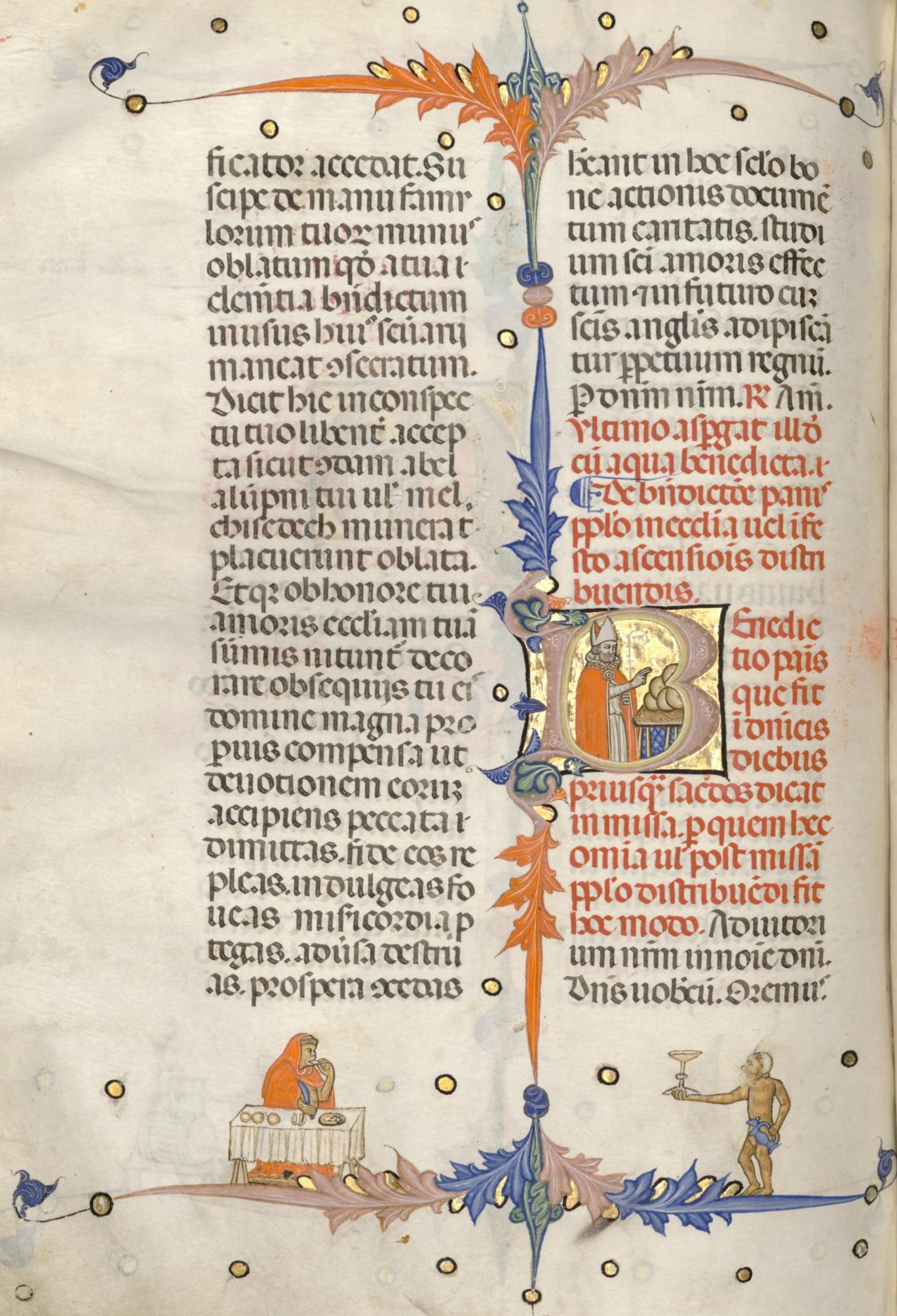
Pontifical of Guillaume Durand (fourteenth century), Paris, Bibliothèque Sainte Geneviève, Ms. 143, f. 172. Public Domain via archive.org/details/BSGMS143
This seminar is supported by PRIN 2020 ETFH3Y (EURIMPER, University of Florence node), financed by the Ministry of University and Research, Italy
Ultimo aggiornamento
19.12.2025