
The Isle of Emotions: Imagining Saint Francis Xavier on Shangchuan Island / Sages, Saints, and Sentiments: When Christian Religious Emotions Meet Confucian Affection
Antonio de Caro (University of Zurich) e Sophie Ling-chia Wei (Chinese University of Hong Kong)
4 December 2025, 10.00-12.00
University Ca' Foscari of Venice, Department of Asian and North African Studies, Online Seminar
Mediterranean Emotions – A Global Research Hotspot
Seminar Series “Emotional Grammars of Globalization”
GMeet Link: https://meet.google.com/iqi-hhdt-ucv
The Isle of Emotions: Imagining Saint Francis Xavier on Shangchuan Island
The island of Shangchuan 上川, where Saint Francis Xavier S.J. (1506–1552) met his end, had been a liminal space for centuries, straddling the line between its cultic significance and its challenging remoteness. Far from the Portuguese enclave of Macau and the major cities of the Chinese empire, such as Guangzhou 廣州, Shangchuan possessed unique and captivating features that inspired artists to depict its landscape and features. This artistic fascination was epitomized by André Reinoso (circa 1590 – after 1650), who painted, in 1619, a portrait of the death of Francis Xavier, coinciding with Xavier’s beatification. After Francis Xavier’s canonization in 1622, the island became a symbol of the inception of Jesuit missions in China and served as a model for numerous missionaries who ventured across the vast Ming and later Qing empires. During his journey to present-day Vietnam in 1637, Fr. Giovanni Battista Bonelli S.J. (1589–1638) (re-)discovered the tomb of the Saint on Shangchuan Island, completely abandoned, and shared his concerns with other missionaries in Macau. As a result, a tombstone was carved in Macau to be placed there, marking the initial effort to restore the cultic significance of the tomb. This endeavor sparked multiple pilgrimages and journeys to Shangchuan Island. Chinese artists also joined this artistic and religious fervor, creating objects meant to be sent to Europe that contained the precious soil of the Saint’s burial place there. This talk explores the cross-cultural interactions that took place on Shangchuan Island, including the emotions experienced by those who visited Francis Xavier’s burial place and those who imagined its liminal aura.
Sages, Saints, and Sentiments: When Christian Religious Emotions Meet Confucian Affection
This talk explores how early-Qing Jesuit translators re-imagined Christian feeling through Confucian virtue to make the Gospel emotionally legible in China. Focusing on Figurist readings of the Yijing (Book of Changes), I show how Jesus was recast not as a distant Western saint but as a Confucian sheng ren—a model sage who embodies loyalty (zhong) and filial piety (xiao). By aligning the sage’s ethical charisma with Christian devotion, Figurists translated religious emotions into a local moral grammar that scholars and officials already lived by. Drawing on Bouvet, Prémare, and Foucquet, the talk traces how symbols and numbers from the Yijing were reinterpreted to narrate creation, fall, and redemption, while the figure of Jesus was clothed in familiar virtues: omniscient, righteous, benevolent—and above all a filial son and loyal minister to the Heavenly Father. This emotional accommodation reframed worship as filial reverence and discipleship as loyal service, bridging two civilizational languages of the heart. By following these translational moves—from omen and hexagram to virtue and feeling—the talk illuminates how “sages, saints, and sentiments” met on shared ethical ground, bringing the Yijing onto a global stage and opening new pathways for comparative study of religion and translation.
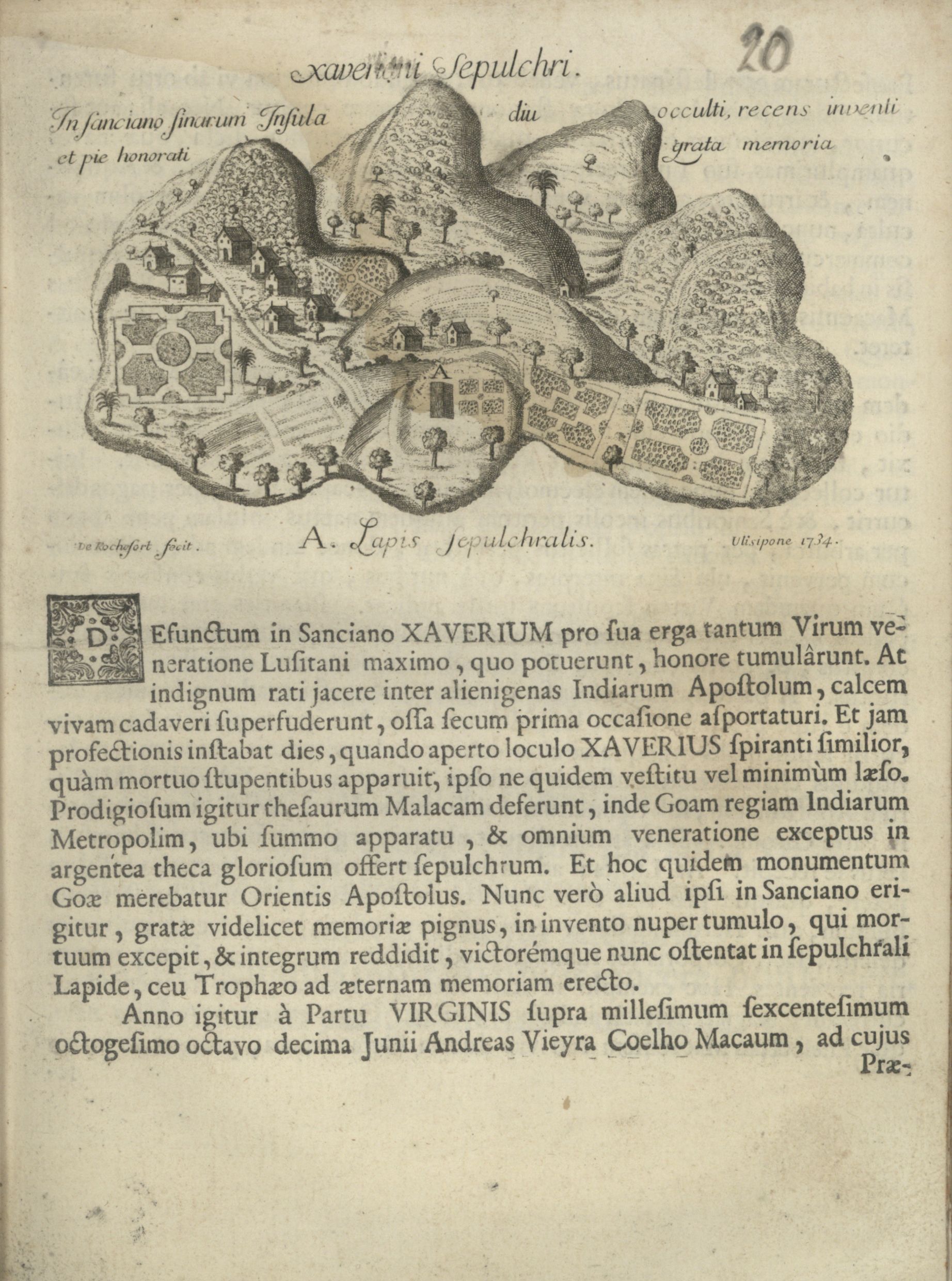
Pierre de Rochefort (engraver), Xaveriani sepulchri in Sanciano Sinarum insula diu occulti, recens inventi et pie honorati grata memoria, Lisbon 1734, Biblioteca Nacional de Portugal © Public Domain Mark 1.0 Universal
Ultimo aggiornamento
19.12.2025